
how to manage hunger thirst in games usually comes down to one thing: turning “reactive eating” into a simple routine you can follow even when everything else goes sideways.
If you play survival-heavy titles, you already know the loop, you’re mid-fight or mid-loot, the screen starts pulsing, and suddenly you’re making bad decisions because your meter hits empty. It’s not hard, it’s just easy to neglect, especially early game.
This guide breaks hunger and hydration into repeatable habits, quick checks, and a couple of lightweight rules that work across genres, from hardcore survival sims to open-world RPGs with meters.

Why hunger and thirst systems feel harder than they should
The tricky part is not the math, it’s timing and attention. These systems punish “I’ll deal with it later,” because later often arrives during travel, combat, or crafting.
- Hidden drain during action: sprinting, overheating, cold exposure, encumbrance, and status effects often accelerate thirst or calories burned.
- Early-game scarcity: you lack storage, cooking tools, and safe water options, so you burn time for small gains.
- Inventory friction: food spoils, water is heavy, and the best items sit in a chest back at base when you need them most.
- Mixed penalties: many games don’t just lower HP; they hit stamina regen, carry capacity, accuracy, or crafting speed, which creates a cascade of losses.
According to CDC, dehydration can affect physical performance and cognitive function, and while a game meter isn’t a medical device, designers often mimic that “worse decisions under pressure” feeling with penalties. If you feel real-world symptoms while gaming, taking a break and hydrating is the safer call, and medical questions belong with a professional.
A fast self-check: what kind of hunger/thirst problem do you have?
Before you change anything, identify the pattern. Most players fall into one of these buckets, and each needs a different fix.
- “I forget”: meters drop to red because you don’t look at them until it’s late.
- “I run out”: you remember, but supplies don’t last through a run.
- “I can’t carry enough”: weight, slots, or spoilage makes prep feel pointless.
- “I don’t know what’s worth eating”: you waste rare items or rely on weak snacks that don’t stabilize you.
- “Water keeps making me sick”: you drink unsafe sources or ignore purification steps.
Key point: if your issue is “I forget,” adding more food won’t solve it; you need a trigger. If your issue is “I run out,” you need a route and a buffer.
Build a simple routine that works across most games
For how to manage hunger thirst in games, a predictable loop beats complicated optimization. You want something you can do without thinking.
The 60-second “leave base” checklist
- Eat one higher-value food item (not your best emergency ration, just solid).
- Fill hydration to comfortable, not necessarily max, unless the game rewards overfilling.
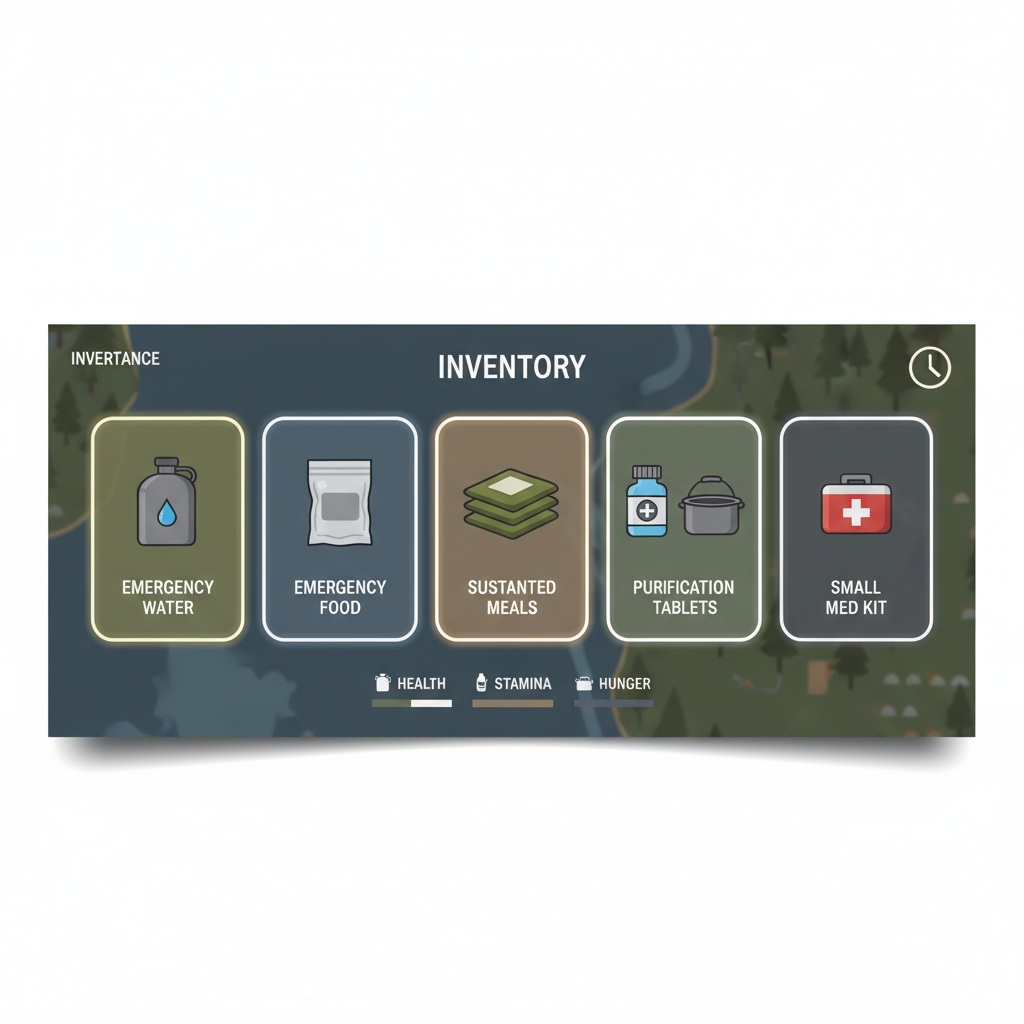
- Pack one emergency stack (fast drink + fast calories) on a dedicated hotbar slot.
- Pack one sustain stack (slow burn food, soups, cooked meals) in inventory.
- Carry one method to make water safe (tablets, filter, pot, campfire kit, depending on title).
The “every 10 minutes” micro-trigger
Set a rule tied to something you already do. Examples: every time you open the map, every time you return to a road, every time you craft, or after each fight. Glance at meters, and if either is below your personal threshold, fix it early.
A good threshold in many games is around 60–70% rather than waiting for warnings, but you should adjust based on penalties, travel length, and how often you can resupply.
Food & water priorities: what to use now vs later
A lot of meter deaths come from using the wrong item at the wrong time, then having nothing left when the game turns hostile.
Here’s a practical table you can adapt to most survival and RPG systems.
| Item type | Best use case | Why it works | Common mistake |
|---|---|---|---|
| Quick snacks (berries, chips, jerky) | Combat, sudden dips, sprint escapes | Fast consumption, low friction | Relying on them as your main diet |
| Cooked meals (stews, grilled meat) | Travel days, base prep, long missions | Better efficiency, sometimes buffs | Carrying too many and losing them to spoilage |
| High-value rations (MREs, rare foods) | Emergencies, harsh biomes, boss prep | High calories, stable, often light | Eating them “because you can” at base |
| Unsafe water (river, puddle) | Last resort only | Keeps you moving when stuck | Drinking repeatedly and stacking debuffs |
| Safe water (purified, bottled) | Default hydration | Predictable, no sickness risk | Overpacking and becoming encumbered |
Practical rule: protect your “panic button” items. If it’s rare, stable, or has special buffs, it belongs in the emergency stack, not the casual snack slot.
Managing weight, slots, and spoilage without overthinking it
Inventory limits are where a lot of plans collapse. You can’t carry a pantry, so you need a plan that assumes scarcity and friction.
- Pick one carry style: either water-heavy (safer, heavier) or purification-heavy (lighter, needs time). Mixing both often wastes space.
- Rotate perishables: take foods that will spoil first on the next run, store stable rations for later.
- Cache supplies: if the game allows it, drop a small stash near choke points, fast travel nodes, or dungeon entrances.
- Cook in batches: many systems reward bulk cooking with less fuel/time per meal, then you take only what you need.
When people ask how to manage hunger thirst in games, this is usually the missing piece: not “more stuff,” but less friction between you and the next refill.
Scenario playbooks (copy these and adjust)
Different loops need different supply logic. Use these as templates.
Long exploration run (no base access)
- Carry 70% sustain food, 30% emergency snacks.
- Bring one backup purification method if the game is punishing about waterborne illness.
- Eat proactively when you pass safe zones, not after you leave them.
Dungeon or mission instance (limited loot time)
- Prioritize quick-consume items and buff foods if available.
- Set a hard rule: refill before each major door/arena.
- Don’t enter with “almost enough” water, instances love to trap you.
Early game (tools missing, sources risky)
- Scout safe water sources, even if it costs time; it pays back quickly.
- Craft the first reliable container before chasing higher-tier gear.
- If cooking is gated, focus on stable, low-spoil foods until you can process raw items.
Common mistakes that quietly drain your meters
These are the “I didn’t realize that mattered” moments that show up across a lot of titles.
- Sprinting everywhere: it feels efficient, but the hunger/thirst tax often wipes out the time you saved.
- Ignoring temperature and clothing: heat and cold systems frequently push hydration or calories harder than travel distance.
- Waiting for the warning icon: by the time the game shouts, you’re already in the penalty zone.
- Eating raw or low-efficiency food: some games let you do it, but the tradeoff is sickness, poor returns, or both.
- Not hotkeying essentials: if consuming takes three menus, you’ll delay, and that delay gets you killed.
If you want the “one-line fix,” it’s this: make refueling easier than looting. Put it on the wheel, on the bar, on muscle memory.
When it makes sense to look up game-specific mechanics
General habits carry you far, but some systems have quirks that change priorities, like “overhydration” buffs, nutrition macros, water containers that freeze, or diseases that require antibiotics instead of rest.
- If you keep getting sick despite purification, check the game’s illness model and tool durability.
- If you’re constantly “full” but still losing stamina, look for separate meters like electrolytes, fatigue, or temperature.
- If hunger feels impossible mid-combat, see whether certain foods lock you into an animation, then swap to faster options.
According to NIH, food safety and water quality matter for illness risk in real life; in games, that concept often maps to “safe source + correct processing.” If a title includes realistic disease mechanics, playing cautiously usually saves more time than brute-forcing through debuffs.
Conclusion: a small system beats willpower
how to manage hunger thirst in games is less about memorizing every recipe and more about having a repeatable pattern: leave base topped off, carry one emergency stack, check meters on a trigger, and treat safe water as a priority resource.
If you want a clean next step, do two things on your next session: set a personal refill threshold around 60–70%, and reorganize inventory so your emergency food and drink sit on dedicated hotkeys. That alone prevents a surprising number of “random” deaths.