
The best free anti cheat for online games is usually the one that fits your platform, your game genre, and your tolerance for intrusive drivers, because “free” often shifts cost into setup time and player friction.
If you run a small multiplayer game, a community server, or even a competitive mod scene, cheating is not just a fairness issue, it quickly becomes a retention problem. Players don’t write long essays when they quit, they just leave after two suspicious matches, and that’s hard to reverse.
This guide narrows the field to realistic free or no-direct-cost options, explains what each can and can’t do, and gives a practical rollout plan so you reduce cheaters without accidentally punishing legitimate players.

What “free anti-cheat” really means (and what it costs you)
Most teams hear “free” and think zero tradeoffs, but anti-cheat is more like a triangle: coverage, intrusiveness, and maintenance. You can pick two, then live with the third.
- No-direct-cost SDKs: some vendors offer free tiers or no upfront fees, but you still invest engineering time, QA, and support.
- Server-side validation: can be cheap in licensing, but costs compute and design effort because you must make the server authoritative.
- Community and admin tools: “free” in money, expensive in moderator hours if your reporting flow is weak.
According to the OWASP, strong security programs rely on layered controls rather than a single mechanism, and anti-cheat works the same way: prevention plus detection plus response tends to hold up better than any one tool alone.
Quick comparison: popular free or no-direct-cost options
Before picking the best free anti cheat for online games, decide your baseline: PC-only competitive shooter needs different controls than a co-op indie title. The table below focuses on what many teams can realistically adopt without paying a standalone anti-cheat license.
| Option | Best for | Strengths | Tradeoffs / watch-outs |
|---|---|---|---|
| Valve Anti-Cheat (VAC) | Steam-distributed titles and server operators | Familiar to players, low friction, integrated with Steam ecosystem | Not a universal SDK for every stack; effectiveness varies by cheat type and game design |
| Easy Anti-Cheat (EAC) | PC games, especially competitive multiplayer | Widely adopted, robust client protections, known workflows | Integration effort, potential player concerns about kernel-level components depending on configuration |
| BattlEye | Competitive PC multiplayer | Strong reputation in certain genres, active cheat mitigation | Licensing and access terms vary; not always “free” in the way indies expect |
| Server-authoritative + validation | Any game where you control backend | Stops many common hacks (speed, teleport, impossible inputs) | Requires careful netcode, can increase server load and dev complexity |
| Reporting + moderation tooling | Community servers, early access titles | Fast wins, builds trust, adaptable to new cheat behaviors | False reports, moderator burnout, slower against subtle cheats |
Two notes that save time: EAC and BattlEye are sometimes described as “free,” but pricing and eligibility can depend on platform relationships or publisher agreements, so you should confirm terms early instead of planning around assumptions.

How to tell what you actually need (a fast self-check)
If you want the best free anti cheat for online games, start by naming the cheats you are losing to. Otherwise you might ship something intrusive that barely touches your real problem.
- Are you mostly seeing “impossible movement” (speed, fly, teleport)? That points to server-side authority and sanity checks.
- Are you seeing aim assistance that looks like high skill? You need detection signals, replay review, and careful ban thresholds.
- Do you have an in-game economy (skins, trading, ranked rewards)? Stronger identity, device risk scoring, and escalation paths matter more.
- Is your game peer-to-peer? Anti-cheat becomes harder; you may need to redesign competitive modes or move key logic server-side.
- What’s your audience tolerance? Some communities accept invasive drivers, others will quit on principle.
Key takeaway
If the server trusts the client for anything valuable, cheaters will eventually take it. Even a simple “position must be reachable in X ms” rule can cut a lot of low-effort cheating.
A practical rollout plan that works even on a small team
Anti-cheat programs fail most often in rollout, not in theory. People rush to bans, then spend weeks handling appeals and review drama.
- Step 1: Instrument first. Add logging for movement deltas, hit rates, input timing, and abnormal state changes. Store enough context to review.
- Step 2: Add soft countermeasures. Shadow bans, trusted matchmaking, rate limits, and server-side corrections reduce harm while you tune detection.
- Step 3: Ship clear player messaging. Explain what you collect, what triggers penalties, and how appeals work. Confusion creates support load.
- Step 4: Tighten in phases. Start with egregious violations, then expand to subtler patterns once you understand false positive risk.
- Step 5: Review weekly. Cheats evolve; your thresholds should too. If you never revisit rules, they rot.
Implementation tips by approach (what to do Monday morning)
Option A: Lean on platform ecosystems (Steam/VAC-like paths)
If your distribution and community live on Steam, platform-native tooling can be the lowest-friction baseline. Make sure your server settings match your enforcement goals, and avoid “silent” rule changes that surprise regulars.
- Verify server configs, ban propagation, and how bans appear to players.
- Set expectations for community servers, especially if you allow mods.
- Keep a lightweight appeal path; even good systems misfire sometimes.
Option B: Client protection (EAC/BattlEye-style)
Client protections can raise the bar quickly, but integration and player trust become part of product work. The goal is not “maximum lock-down,” it is “enough friction that most cheaters leave.”
- Plan QA time for crashes, performance regressions, and edge devices.
- Write a privacy note in plain English so players don’t fill the gap with rumors.
- Have a fallback mode for unsupported systems, even if it means unranked-only.
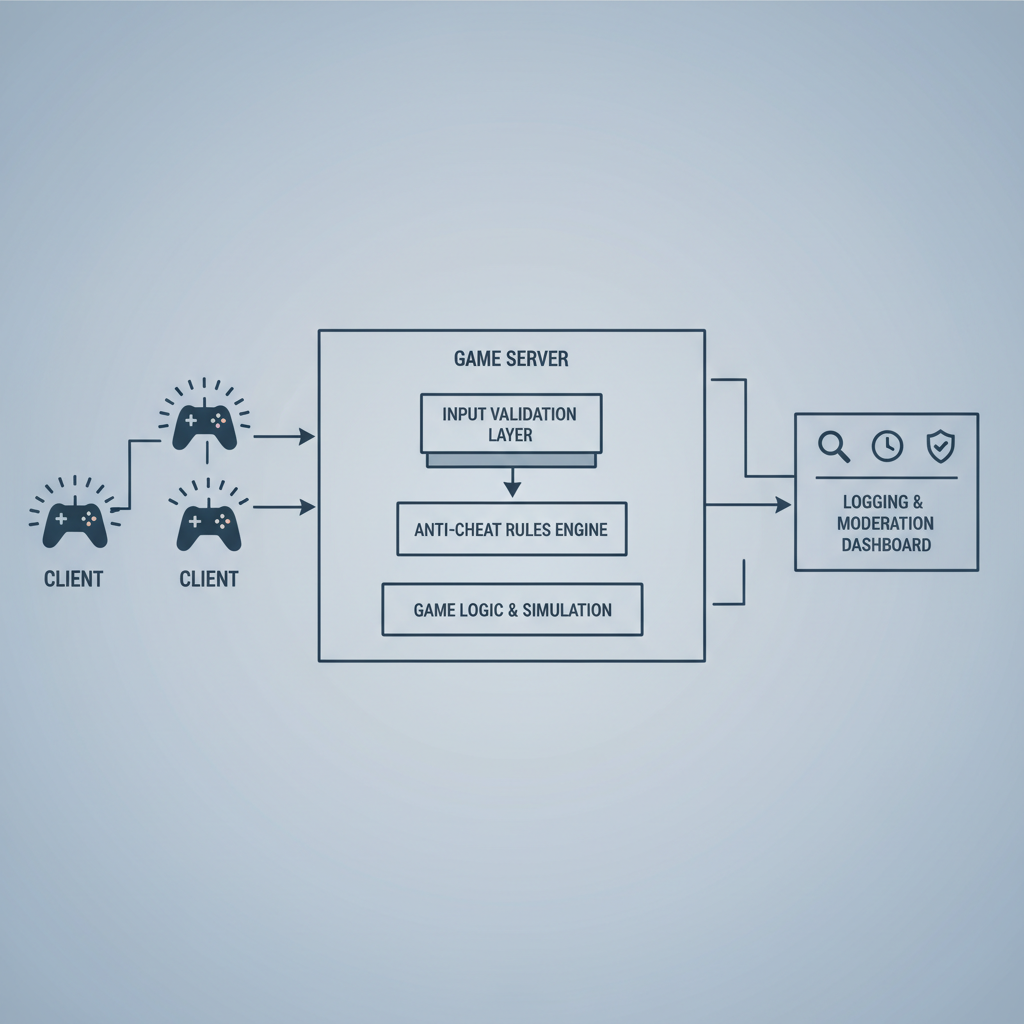
Option C: Server-authoritative design + validation rules
This is the most “yours forever” approach. It also tends to be the closest thing to a free anti-cheat that stays effective over time, because you’re removing trust rather than playing whack-a-mole with signatures.
- Move critical checks server-side: damage, inventory, cooldowns, movement constraints.
- Add sanity checks with safe corrections, not instant bans, until tuned.
- Use replay or event snapshots for review when you do start banning.
Common mistakes that quietly make cheating worse
- Banning based on one stat. High headshot rate alone can be skill, hardware, or matchmaking imbalance. Use multiple signals.
- No appeal process. Even a small form and a human review window can prevent public blow-ups.
- Publishing exact thresholds. Transparency matters, but exact numbers help cheat devs tune around you.
- Ignoring the economy. If cheaters can launder value through trades or drops, bans become a minor speed bump.
- Letting moderators “freestyle.” Without policy, enforcement looks biased, and players notice fast.
According to NIST, security controls should be documented and repeatable, and that mindset helps anti-cheat too: consistent enforcement usually beats “hero admin” enforcement.
When you should consider paid help or a specialist
Free tools get you far, but some situations justify bringing in a vendor or security engineer, even short-term.
- You run cash tournaments, high-stakes ranked ladders, or regulated esports workflows.
- Your game attracts cheat sellers, not just casual script users.
- You see account takeovers, payment abuse, or large-scale botting alongside gameplay cheating.
- False positives become a support crisis and you need better telemetry and review tooling.
If legal questions come up around data collection, bans, or privacy disclosures, it’s smart to consult a qualified attorney, since requirements can vary by state, platform policy, and your audience age.
Conclusion: picking a “best” free option without getting stuck
The best free anti cheat for online games is rarely a single product name, it’s a sensible stack: server-side validation for what must be true, client protection when your audience accepts it, and clear moderation tooling so honest players feel heard.
If you want a simple next move, pick one cheat category you can measure this week, add logging plus a gentle mitigation, then only escalate to bans after you confirm low false positives. That pacing feels slower, but it usually prevents the messy “ban wave then apology” cycle.
Key points to remember
- Design beats detection when you remove client trust for valuable actions.
- Telemetry first makes every later decision easier and more defensible.
- Player trust is part of anti-cheat, especially when tools touch the client system.
FAQ
What is the best free anti cheat for online games on Steam?
For many Steam-centric communities, VAC and Steam ecosystem controls can be a reasonable baseline, mainly because setup and player expectations are already aligned. Your results still depend on game design and whether the server trusts the client too much.
Is a server-authoritative approach “better” than client anti-cheat?
Often it’s more durable, because it blocks whole categories of manipulation by design, not by detection. But it can increase backend complexity and may require refactoring movement, hit registration, or inventory logic.
Can I rely only on player reports and moderators?
You can, especially early on, but it tends to miss subtle cheats and can burn out volunteers. Reports work best when paired with replays, logs, and consistent enforcement rules.
Do free anti-cheat tools cause performance issues?
They can, depending on how the client component interacts with drivers, overlays, and older hardware. It’s worth running staged rollouts and keeping crash reporting tight so you can separate anti-cheat issues from general bugs.
How do I reduce false bans without letting cheaters roam?
Use multiple signals, start with “soft” actions like matchmaking segregation, and require strong evidence for permanent bans. Keep an appeal workflow, even if it’s lightweight, because edge cases happen.
What cheats are hardest to detect with free methods?
Low-assist aim tools, humanized trigger behavior, and “legit-looking” wall information tend to be tricky without deeper client telemetry, replay review, or more advanced analytics.
Is kernel-level anti-cheat safe?
It can be safe when implemented and maintained responsibly, but it also increases risk surface and raises privacy concerns for some players. If you go that route, clear disclosure and strong update hygiene matter, and you may want professional security review.
How long does it take to see results after adding anti-cheat?
Many teams see quick improvements against obvious hacks, but stable results usually take weeks because you’re tuning thresholds, closing loopholes, and adapting to new patterns.
If you’re trying to stop cheating without turning your game into a support nightmare, a good next step is to list your top three cheat complaints, map each to a measurable signal, then choose the lightest control that actually addresses it. If you need a more hands-off path, consider starting with platform-native protections plus a small set of server-side validations, then expand only where your data shows real pain.