
Top games with time manipulation mechanics usually fall into two buckets: clever puzzles that make you feel smart, and action games where rewinding a mistake feels like a superpower.
The problem is choice overload, because “time manipulation” can mean anything from a quick rewind button to a full-on timeline you can edit, and the experience changes a lot depending on how it’s implemented.
This guide narrows it down with practical categories, a comparison table, and a few quick ways to match the right game to your mood, skill level, and platform.

What “time manipulation” actually means in games
Players often use the phrase like it’s one feature, but designers treat it as a toolbox. If you know which tool you enjoy, picking from top games with time manipulation mechanics gets much easier.
- Rewind: undo recent actions, often to fix combat mistakes or redo a puzzle step.
- Time pause / bullet time: slow the world to aim, dodge, or plan.
- Time loops: replay a fixed window, carrying knowledge forward each run.
- Timeline branching: choices create diverging outcomes you can revisit or reshape.
- Time travel puzzles: cause-and-effect across eras, moving objects or information between periods.
According to the Entertainment Software Association (ESA), the U.S. player base spans a wide range of ages and play styles, so it’s no surprise these mechanics show up in everything from narrative adventures to hardcore action titles. In practice, your enjoyment depends less on “time travel” as a theme and more on how much control the game gives you.
Quick comparison table: standout picks at a glance
If you want a fast shortlist, this table focuses on what you’ll feel moment-to-moment: what you do with time, and what kind of game it is.
| Game | Time mechanic focus | Genre vibe | Why people remember it |
|---|---|---|---|
| Prince of Persia: The Sands of Time | Rewind + limited resource | Action-adventure platforming | Mistakes become part of the flow, not a reload screen |
| Braid | Rewind + rule-bending time puzzles | Puzzle platformer | Time becomes the core “language” of every level |
| Life is Strange | Choice rewinds | Narrative adventure | Emotional consequence, even when you can take it back |
| Dishonored | Time stop (with upgrades) | Stealth-action immersive sim | Creative sandbox solutions feel authored by you |
| SUPERHOT | Time moves when you move | Action puzzle shooter | Every fight feels like a choreographed plan |
| Outer Wilds | Time loop knowledge progression | Exploration mystery | Discovery replaces grind, curiosity replaces quests |
| The Legend of Zelda: Majora’s Mask | Three-day cycle loop | Adventure with schedules | A living world you learn to “read” over repeats |
| Quantum Break | Time powers + narrative branching | Cinematic action | Flashy set pieces built around time chaos |
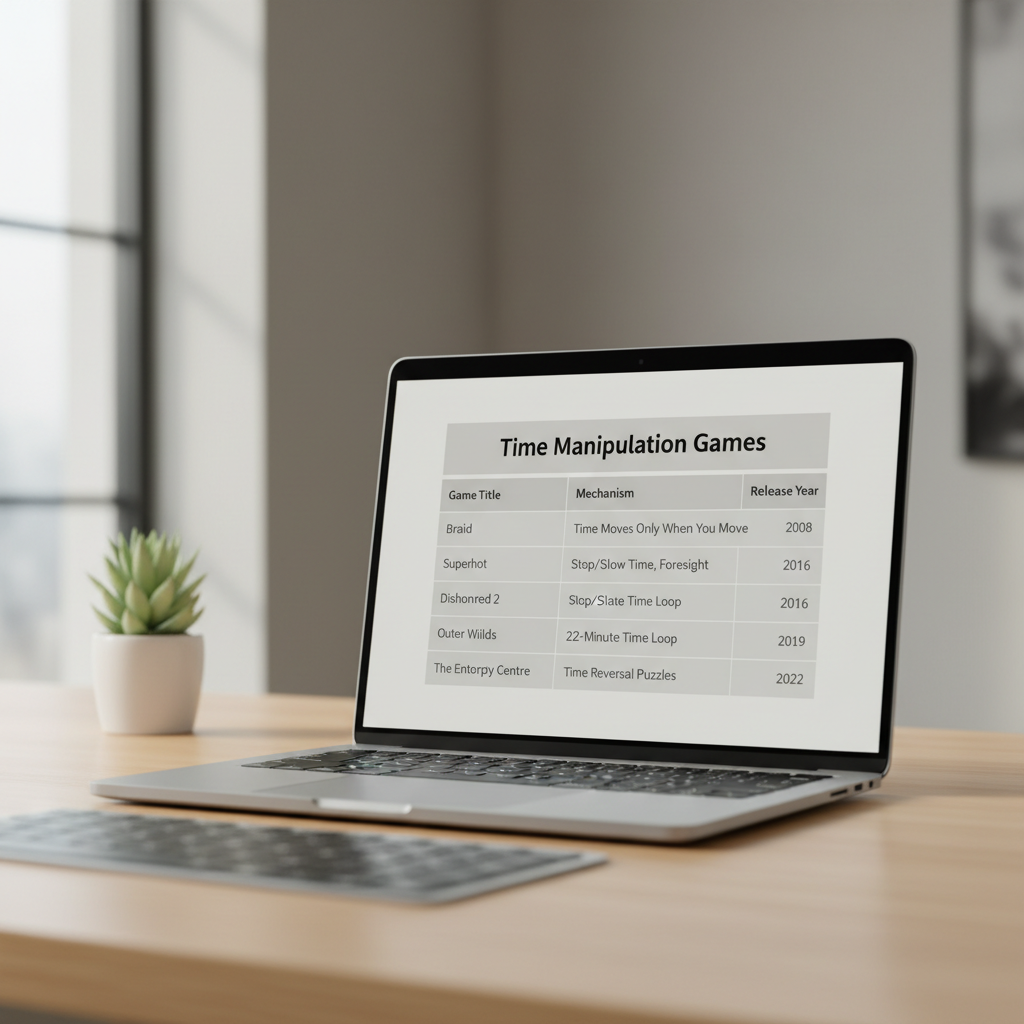
The top games with time manipulation mechanics (and what they do differently)
Here’s the curated list, with the “why it works” angle. Not every game uses time as a gimmick; the best titles make it the reason the whole design holds together.
Prince of Persia: The Sands of Time
The rewind isn’t just convenience, it’s pacing. You try riskier jumps and fights because the penalty feels fair, and the game stays in motion instead of stopping for reloads.
- Best for: players who want classic action-platforming with a forgiving edge
- Watch for: rewind limits, which keep tension intact
Braid
If you like puzzles where the rule changes each chapter, this is still a reference point. The “time” part keeps evolving, and solutions often feel like a small revelation.
- Best for: puzzle lovers who enjoy experimentation
- Watch for: some puzzles reward patience more than reflex
Life is Strange
Rewinding dialogue choices sounds like a power fantasy, but the writing pushes back. Even when you can redo a moment, you still have to live with larger consequences.
- Best for: story-first players
- Watch for: emotionally heavy themes, depending on your comfort level
Dishonored (time stop builds)
Time stop in a stealth sandbox becomes a creativity engine. You freeze a guard’s awareness, reposition, chain abilities, and suddenly you’re inventing your own “perfect run.”
- Best for: stealth players who like freedom and replayability
- Watch for: the game rewards planning, but improvisation works too
SUPERHOT
This one flips expectations: you’re not “reacting fast,” you’re thinking. Because time crawls when you stand still, every room becomes a tactical puzzle with guns.
- Best for: players who want stylish, readable action
- Watch for: short sessions can be more satisfying than long binges
Outer Wilds
It’s a time loop where progress is knowledge, not gear. If you bounce off objective markers and love piecing mysteries together, it’s hard to beat.
- Best for: explorers, lore hunters, puzzle solvers
- Watch for: early confusion is normal, it clicks after a few loops
The Legend of Zelda: Majora’s Mask
The repeating schedule makes NPC routines matter. You learn where someone will be, when a door unlocks, what changes if you intervene, then you plan the “best” use of a cycle.
- Best for: players who like worlds that feel scheduled and reactive
- Watch for: time pressure can feel stressful, even if it’s manageable
Quantum Break
Time stutters and collapses turn into action spectacle, but there’s also a narrative branching layer. It’s a good pick when you want time powers without giving up blockbuster pacing.
- Best for: cinematic action fans
- Watch for: the balance tilts toward action over deep puzzle design
Self-check: which time-bending style will you actually enjoy?
Before you buy or reinstall, a quick gut check saves you from picking the “most famous” option that you never finish. Many top games with time manipulation mechanics are great, but not great for every mood.
- I want to fix my mistakes without losing momentum → lean toward rewind action (Sands of Time) or forgiving puzzle design (Braid).
- I care more about choices and consequences → narrative rewind (Life is Strange) tends to land better.
- I like stealth and creative problem solving → time stop in a sandbox (Dishonored) fits.
- I want combat that feels like planning a heist → movement-based time (SUPERHOT).
- I enjoy mysteries where I connect dots → loop-as-knowledge (Outer Wilds).
- I get stressed by countdowns → avoid strict schedule loops at first, or play them in shorter sessions.
Key point: if you’re tired after work, “time manipulation” that demands heavy note-taking can feel like homework, even when it’s brilliant.

Practical tips: how to get more fun out of time mechanics
Time powers can make you overthink, especially if you feel you must find the “perfect” outcome. A few habits keep the mechanic playful instead of paralyzing.
- Set a failure budget: decide you’ll only rewind three times in a fight or puzzle before you accept the mess and move on.
- Use time tools to explore, not optimize: in narrative games, sometimes the first choice is the truest one.
- When stuck, change the question: instead of “what’s the solution,” ask “what rule is this level teaching me about time?”
- Short sessions help loop games: time-loop structure often feels better in 30–60 minute chunks.
According to the International Game Developers Association (IGDA), accessibility and player experience design are common topics in modern development discussions, and time mechanics can be part of that when they reduce frustration. Still, some implementations add cognitive load, so it’s okay to pick the one that matches your energy.
Common mistakes (and what to do instead)
A lot of players bounce off these games for reasons that aren’t about skill, they’re about expectations.
- Mistake: treating rewind like a requirement to be perfect. Try: use it to learn patterns, then commit.
- Mistake: buying a “time loop” game expecting constant action. Try: approach it like a mystery novel you play.
- Mistake: assuming all time travel stories branch the same way. Try: check whether choices truly diverge, or mostly change flavor and scenes.
- Mistake: ignoring comfort settings. Try: adjust motion blur, camera sensitivity, or difficulty so the time mechanic stays enjoyable.
Wrap-up: picking your next time-bending game
If you want a safe bet, pick one game where time manipulation supports your favorite genre, not one where you hope the mechanic will change your taste overnight. The best top games with time manipulation mechanics feel natural because they match your preferred pace.
Two simple moves: choose one rewind-style title for instant satisfaction, and one loop or narrative title for a slower burn, then alternate depending on your mood.
Key takeaways
- Rewind tends to reduce frustration and encourage experimentation.
- Time loops reward curiosity and pattern recognition more than grinding.
- Time stop / slow shines when the game gives you multiple solutions, not one “correct” path.
FAQ
What are the best top games with time manipulation mechanics for beginners?
Many beginners prefer rewind or slow-time mechanics because they feel intuitive. Games like Sands of Time and SUPERHOT tend to teach the concept quickly without demanding deep systems knowledge.
Are time-loop games stressful if I don’t like timers?
They can be, depending on how strict the loop feels and how much you lose each cycle. If timers make you anxious, start with shorter play sessions and pick loop games where knowledge carries you forward in a clear way.
Which time manipulation games are best for story and choices?
Life is Strange is a common entry point because the time mechanic sits directly inside dialogue and decision-making. If you want branching, check whether the game emphasizes different endings or more subtle scene variations.
Do time mechanics make games easier?
Sometimes, but not always. Rewind often makes failure less punishing, yet puzzles can become more complex to compensate, and combat games may limit the ability with resources or cooldowns.
What’s the difference between rewind and save scumming?
Rewind is usually designed as part of the flow, fast to use and balanced around. Reloading saves can work, but it often breaks pacing and can make you play overly cautious.
What should I play if I like puzzles more than combat?
Braid remains a strong pick because time rules are the puzzle itself. For a different flavor, exploration mysteries like Outer Wilds can scratch the same itch, just with more wandering and discovery.
Are there accessibility concerns with time manipulation mechanics?
There can be, because rapid camera movement or repeated loop resets may cause discomfort for some players. If you’re sensitive to motion or stress, consider enabling comfort settings and, if needed, ask a medical professional for advice about screen-related symptoms.
If you’re trying to decide between a few titles, it can help to share what you like most—puzzles, stealth, story, or pure action—and your platform, then build a short list that matches your pace instead of chasing whatever is trending.