
Best games with physics based puzzles are the ones where the rules feel consistent enough to learn, but surprising enough to keep you experimenting instead of Googling solutions. If you’ve ever bounced off a “physics puzzle” game because it felt random, too fiddly, or overly punishing, you’re not alone.
The good news is that physics puzzles aren’t one genre, they’re a spectrum. Some games focus on clean, toy-like interactions and gentle problem solving, others lean into engineering sandboxes where failure is part of the fun, and a few use physics more like a comedy engine than a strict simulation.
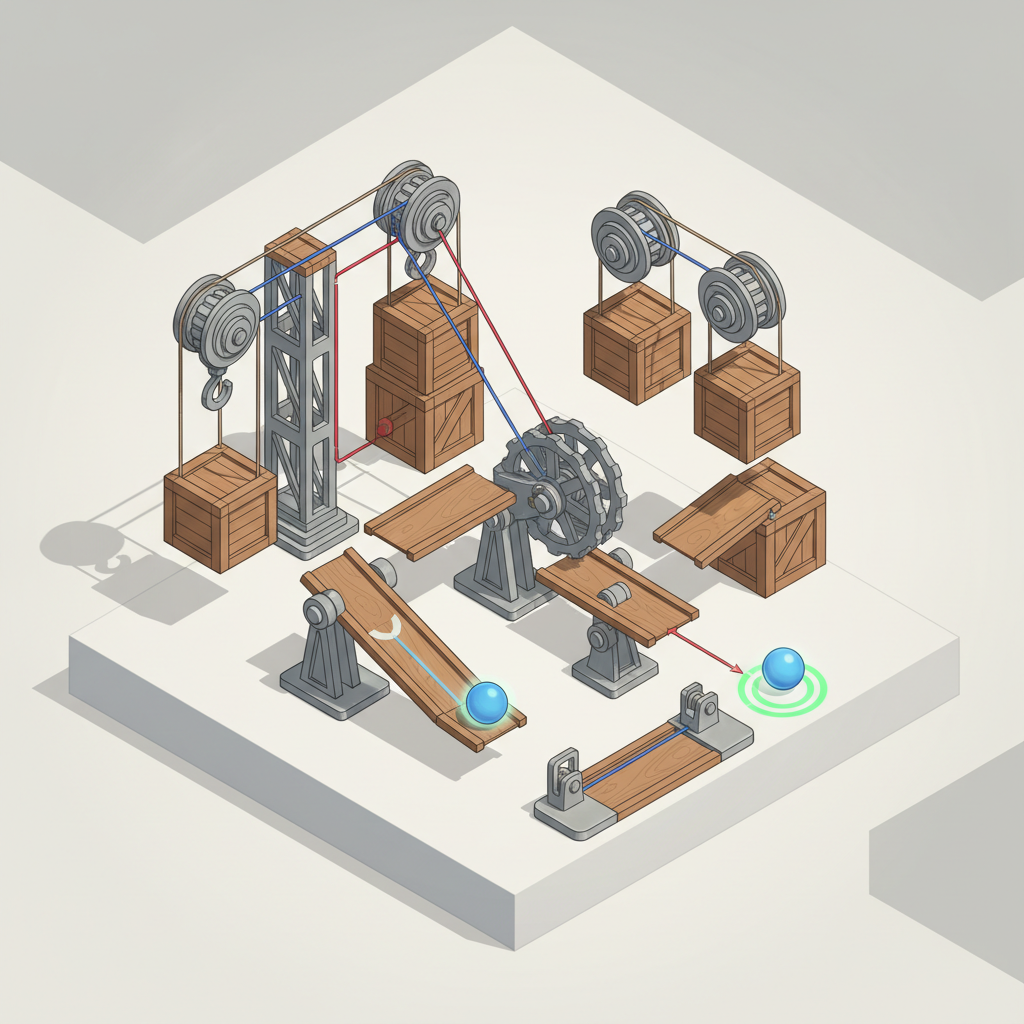
This guide is built for picking, not just browsing. You’ll get a quick comparison table, a “what you actually like” checklist, and practical tips for enjoying physics puzzles without turning every level into a frustration loop.
What “physics-based puzzles” really means (and why it matters)
In most discussions, physics-based puzzles means the game lets you solve problems through interactions like momentum, gravity, friction, balance, buoyancy, electricity, or structural stress, rather than only through fixed “use item A on slot B” logic. The key is that the world reacts to what you do.
That detail matters because it changes how solutions feel. In a strong physics puzzler, you can often reach the same goal in multiple ways, and the game rewards observation and iteration. In a weaker one, the physics can feel inconsistent, or the “intended” solution is so narrow it might as well be a traditional puzzle.
According to ESA (Entertainment Software Association), puzzle games remain a consistent part of how people play across age groups, which tracks with why physics puzzles stick around: they’re approachable, but still make you feel clever when the pieces finally behave.
Quick comparison: popular picks by vibe, platform, and frustration level
If you just want a fast shortlist, this table helps you narrow down the best games with physics based puzzles based on how they tend to feel in real play.
| Game | Best for | Physics style | Typical vibe | Platforms (common) |
|---|---|---|---|---|
| Portal 2 | Smart, readable puzzles | Momentum, portals | Witty, polished | PC, consoles |
| Human: Fall Flat | Co-op chaos | Ragdoll, weight | Silly, emergent | PC, consoles, Switch |
| The Talos Principle 2 | Big brain + philosophy | Lasers, forces | Reflective, complex | PC, consoles |
| Baba Is You | Rule-bending logic | Not sim-physics, but systemic | Brilliant, tough | PC, consoles, Switch |
| World of Goo | Creative building | Structures, tension | Charming, tricky | PC, mobile, consoles |
| Besiege | Engineering sandboxes | Rigid body simulation | Inventive, chaotic | PC, consoles |
| Poly Bridge (series) | Optimization tinkering | Loads, suspension | Zen, iterative | PC, mobile, Switch |
| Bridge Constructor: Portal | Hybrid puzzle flavor | Structural + Portal mechanics | Playful, structured | PC, consoles, mobile |

Top recommendations: the best games with physics based puzzles (by scenario)
Rather than rank everything on one ladder, it’s more useful to match a game to how you like to think. Here are dependable picks that players keep returning to, for different reasons.
If you want clean “aha” moments: Portal 2
Portal 2 is still a reference point because the physics feels legible. You learn momentum through play, the game teaches without lecturing, and later puzzles remix ideas without turning into pure trial-and-error.
- Why it works: consistent rules, multiple solution paths, excellent pacing.
- Watch-outs: if you dislike first-person perspective, it may take a session to click.
If you want co-op laughter and “that shouldn’t work, but it does”: Human: Fall Flat
Human: Fall Flat is physics as slapstick, but there’s real puzzle solving underneath. Grabbing, pulling, tipping, and improvising become the toolkit, especially with friends.
- Why it works: emergent solutions, low pressure, great co-op.
- Watch-outs: controls can feel wobbly by design, which some players read as “janky.”
If you want serious challenge with a systemic feel: The Talos Principle 2
The Talos Principle 2 sits closer to a cerebral, structured puzzle game, but it uses physical interactions with beams, connectors, and force-like mechanics that reward careful planning.
- Why it works: layered puzzles, strong sense of progression.
- Watch-outs: if you want quick wins, the later areas can feel dense.
If you want engineering and iteration: Poly Bridge (series) or Besiege
If your brain enjoys “build, test, adjust, repeat,” go for Poly Bridge. If you want more chaotic invention, Besiege gives you the joy of machines that almost work, then suddenly do.
- Why it works: creativity, experimentation, satisfying feedback loops.
- Watch-outs: these can become time sinks, and perfectionism sneaks in fast.
If you like building with personality: World of Goo
World of Goo remains a classic because it turns structural physics into something playful and weirdly emotional. You build, things wobble, you hold your breath, then you either stabilize or collapse.
- Why it works: simple inputs, surprisingly deep construction puzzles.
- Watch-outs: a few levels can feel tight if you approach them too rigidly.
Self-check: which kind of physics puzzle player are you?
Before you buy another game that looks perfect in a trailer but frustrates you in an hour, do a quick gut-check. The point is to match best games with physics based puzzles to your tolerance for ambiguity.
- You enjoy tinkering if you replay the same level gladly to shave off mistakes.
- You enjoy clarity if you want to understand the rule set within minutes.
- You enjoy chaos if “unexpected” feels funny, not unfair.
- You hate fiddly controls if you blame the input before you blame the plan.
- You like optimization if you keep thinking “there’s a cleaner build.”
Key point: if you score high on “clarity” and low on “chaos,” prioritize games with tight rule teaching and stable interactions, not ragdoll-heavy sandboxes.
How to get unstuck without ruining the fun
Physics puzzle games can feel like a wall when the simulation has many moving parts. A few habits keep the experience satisfying, especially if you’re playing solo.
- Reduce the problem: test one variable at a time. Move one object, change one angle, swap one material.
- Look for invariants: what stays true no matter what you try, like weight limits, timing windows, or a fixed energy source.
- Use “ugly prototypes”: build a messy but functional solution, then refine. Many players skip this and stall.
- Switch goals for five minutes: explore the level edges, check alternate routes, try the “wrong” approach on purpose.
If you do watch hints, try this rule: stop at the first nudge. Full solutions often kill the learning that makes these games rewarding.
Common mistakes when choosing physics puzzle games (and what to do instead)
A lot of disappointment comes from mismatched expectations, not “bad games.” A few patterns show up repeatedly.
- Mistake: buying for realism. Do instead: buy for consistency. Even cartoony physics can feel fair if rules hold.
- Mistake: assuming all physics puzzles are chill. Do instead: check whether the game is an optimizer, a sandbox, or a linear puzzler.
- Mistake: forcing perfect solutions early. Do instead: aim for “works once,” then improve.
- Mistake: blaming yourself for control friction. Do instead: watch 2 minutes of raw gameplay; you’ll see if the handling style fits.
Also, be honest about your play context. If you play in short sessions, games with long build-test loops may feel slower than you want, even if they’re excellent.
Buying tips: what to look for on store pages and reviews
Store tags can be vague, and trailers hide frustration. When you’re shopping for the best games with physics based puzzles, these signals tend to be more reliable.
- Look for stable teaching: mention of “gradual difficulty,” “training chambers,” or “introduces mechanics well.”
- Check failure cost: quick reset buttons, generous checkpoints, undo features for builders.
- Confirm input feel: controller vs mouse-and-keyboard can change the experience a lot.
- Find out how many solutions exist: reviews that say “I solved it differently than my friend” are a green flag.
According to Valve (Steam) documentation on reviews and discovery tools, user reviews are most useful when filtered by recent play and specific tags. Practically, that means reading the negative reviews first, then deciding if those complaints apply to you.
Conclusion: a simple way to pick your next physics puzzler
If you want one safe starting point, Portal 2 remains hard to beat for readable mechanics and satisfying “click” moments. If your ideal night is messing around with friends, Human: Fall Flat makes physics feel like a party trick. If you love iterative building, Poly Bridge or Besiege will likely keep you busy for a while.
Action you can take today: pick one game based on your self-check, then watch a short, unedited gameplay clip before buying. That one step prevents most “this isn’t what I thought” purchases.
FAQ
What are the best games with physics based puzzles for beginners?
Portal 2 is usually a friendly entry because it teaches mechanics cleanly and ramps difficulty with care. World of Goo also works if you prefer building and experimenting at your own pace.
Are physics-based puzzle games more about logic or trial and error?
The better ones lean on logic, but iteration is part of the genre. If resets are fast and rules stay consistent, “trial” turns into learning instead of guessing.
Which physics puzzle games are best for co-op?
Human: Fall Flat is a common pick because players can improvise together and laugh at failures. Some puzzle games offer co-op modes too, but the feel varies a lot by implementation.
Do physics puzzles run well on Switch or older PCs?
Many do, especially smaller-scale titles, but performance can vary by game and level complexity. If frame rate matters to you, check recent platform-specific reviews before buying.
What if the physics feels “janky,” is that bad design?
Sometimes it’s intentional, especially in ragdoll-focused games where wobble creates humor. If you want precision, stick to titles known for tight controls and predictable interactions.
Is Baba Is You a physics puzzle game?
Not in the simulation sense, but it is physics-adjacent in spirit because it’s deeply systemic and experiment-driven. If you like rule manipulation, it can scratch a similar itch.
How do I stop looking up solutions and still make progress?
Set a time box, like 10–15 minutes, and only search for hints (not full answers) when you’re truly stuck. You keep the “aha” moment while avoiding the spiral.
If you’re trying to build a short “next three games” list and want it to match your play style, budget, and platform, a lightweight way is to share what you liked and hated in your last puzzle game, then narrow choices to two or three with the same physics vibe rather than chasing whatever is trending.